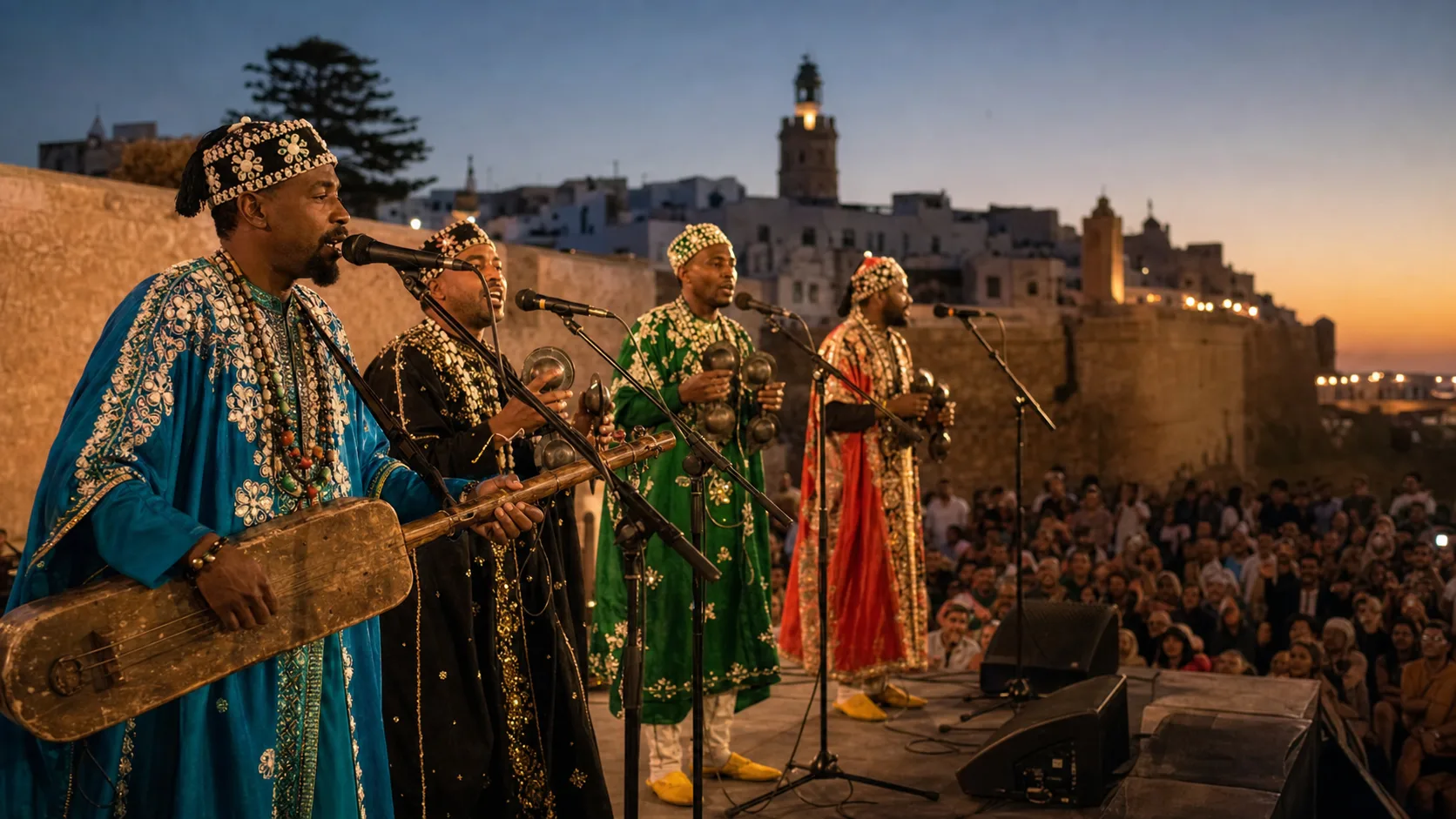
Essaouira is one of Morocco's great music towns — and the spiritual home of Gnaoua (also spelled Gnawa), a hypnotic, trance-driven music and healing tradition with deep sub-Saharan African roots. Its flagship event, the Gnaoua and World Music Festival, usually fills the whole town over a long weekend in late June (the exact dates are set and announced each year), and much of it has traditionally been free and open-air. But the best news for travellers is that the music lives here all year: you don't have to time your trip to June to feel it. After years of welcoming guests around the festival and on quiet off-season nights, that's our honest, on-the-ground take.
The short answer
What is it? Gnaoua — spiritual, trance-building music led by a master (maâlem) on a three-string bass lute (guembri) with iron castanets (qraqeb). When's the festival? A long weekend, usually late June — but check the official dates each year. Is it free? Much of it traditionally is, on the public stages. Outside June? Yes — live Gnaoua surfaces in riads, cafés and the medina year-round, though never guaranteed on a given night.
What is Gnaoua music, exactly?
Gnaoua is far more than a folk genre — it's a spiritual and therapeutic tradition carried down from sub-Saharan West Africans brought into Morocco centuries ago, fused over generations with Moroccan Sufi and Berber currents. Musically you'll know it instantly: a deep, looping bass line on the guembri (a skin-covered three-stringed lute, also called the sintir or hajhouj), the bright metallic clatter of iron castanets called qraqeb, hand-clapping, and a leader-and-chorus call-and-response that slowly, patiently builds toward trance. The musicians are led by a maâlem — a master player who is part bandleader, part spiritual guide. In 2019 Gnawa was inscribed on UNESCO's Representative List of the Intangible Cultural Heritage of Humanity, formal recognition of a living tradition rather than a museum piece.
Why Essaouira, of all places?
Essaouira — the old port of Mogador — has long been a meeting point of cultures: Amazigh, Arab, Andalusian, Jewish and sub-Saharan African, all trading and living within the walls. That mix made it a natural heartland for Gnaoua, and the town is home to respected maâlems and families who keep the practice alive. When the Gnaoua and World Music Festival launched here in the late 1990s, it didn't invent the town's relationship with the music — it amplified something that was already in the walls. That's why a quiet evening of Gnaoua in a small Essaouira riad can feel just as authentic as a packed festival square.
When is the Gnaoua and World Music Festival?
The festival usually runs over a long weekend, typically in late June — but this is a pattern, not a guarantee. The organisers set and announce the dates each year, so always confirm against the current official programme before you book flights or rooms. Roughly: expect a Thursday-to-Sunday rhythm in the second half of June, with the town busiest and most electric across those days.
One thing we will say plainly: book accommodation months ahead. The festival draws hundreds of thousands of people and Essaouira sells out completely — riads, hotels and coast guesthouses alike. If your heart is set on the festival, lock in a place well before you finalise anything else. Our where-to-stay guide covers the medina riads and neighbourhoods that go first.
Is it free, and what's it actually like?
Much of the festival has traditionally been free and open-air: large public stages in the main squares and along the seafront where Gnaoua maâlems share the bill with jazz, world and fusion artists from across the globe. Some night concerts and the more intimate, ritual-leaning sessions have been ticketed or invitation-based. Because programmes and ticketing shift from year to year, treat this as the general shape and check the official listings for your dates.
The atmosphere is the real draw: the medina overflowing, processions of musicians moving through the lanes, the ramparts and Place Moulay Hassan thick with people, and the famous "fusion" sets where a Gnaoua maâlem locks in with a visiting jazz or world band and something genuinely new happens on stage. It is joyful, loud and crowded — wonderful if you love a festival crush, less so if you came to Essaouira for its usual calm. If quiet is what you're after, come outside June (more on that below).
Can you hear Gnaoua year-round?
Yes — and this is the part most visitors miss. Because Essaouira is a true home of the music rather than just its festival host, live Gnaoua surfaces throughout the year. Some riads, cafés, cultural spaces and restaurants host Gnaoua evenings, and you may simply round a corner in the medina and find musicians playing. None of it runs to a guaranteed nightly schedule, so the move is simple: ask your riad or a local guide what's on while you're in town. Our guide to Essaouira evenings and live music and the Gnaoua and music things-to-do guide point you in the right direction.
The lila — the music's deeper side
Beneath the festival stages lies the lila (or leila, "night"): the traditional all-night Gnaoua ceremony of music, incense, colour and trance, led by a maâlem for healing and spiritual connection rather than for an audience. It is the root of everything you'll hear on the public stages. Lila-style sessions sometimes appear during the festival and in cultural settings around town. If you are ever invited to a traditional lila, treat it as the sacred ceremony it is — follow your host's lead, dress and behave modestly, and always ask before you photograph. Respect here is not just etiquette; it's the whole point.
How to fold Gnaoua into your trip
If the festival is your reason to come, build the trip around it: confirm the year's dates early, book a riad inside or near the medina months ahead, and give yourself a calm day or two on the coast on either side to recover from the crowds — our four-day Gnaoua festival itinerary does exactly that. If you'd rather have the music without the crush, come in spring or autumn, stay a few nights, and ask around for a live evening — you'll likely hear Gnaoua with room to breathe. Either way, pair it with the rest of the town: the breezy summer coast, the seafood, the ramparts and the slow medina. For how the festival sits among the town's other events, our Essaouira festivals calendar maps the whole year.
Our take
Gnaoua is the soul of Essaouira as surely as the wind is its weather. The June festival is a genuine bucket-list experience — generous, largely free and unlike anything else in Morocco — but you don't have to wait for it. Come knowing the dates change each year, book far ahead if you want the festival, or simply come any season, ask what's playing, and let the guembri find you. Tell us your dates and what you're after — a front-row festival or a quiet riad evening — and we'll shape the right version for you.
Browse our Essaouira tours and experiences or get in touch to plan a trip around the music.
Frequently asked
What is Gnaoua music?
Gnaoua (also spelled Gnawa) is a Moroccan spiritual music and healing tradition rooted in the heritage of sub-Saharan West Africans brought to Morocco centuries ago. It blends deep, hypnotic bass lines played on the guembri — a three-stringed skin-covered lute, also called the sintir or hajhouj — with the metallic clatter of iron castanets (qraqeb), hand-clapping and call-and-response singing. Led by a master musician known as a maâlem, it builds slowly into a trance. In 2019 Gnawa was inscribed on UNESCO's Representative List of the Intangible Cultural Heritage of Humanity.
When is the Gnaoua Festival in Essaouira?
The Gnaoua and World Music Festival usually takes place over a long weekend, typically in late June, but the exact dates are set and announced each year, so always check the official programme before you book. The festival has run in Essaouira since the late 1990s and is the town's flagship cultural event — treat any month or dates here as the usual pattern rather than a fixed promise.
Is the Gnaoua Festival free?
Much of it traditionally is. For years the main public stages in the squares and along the seafront have been free and open to all, which is a big part of the festival's open, generous spirit, while some night concerts and intimate all-night 'lila' sessions have been ticketed or invitation-based. Programmes and ticketing can change year to year, so check the current official listings rather than relying on past editions.
Can you hear Gnaoua music in Essaouira outside the festival?
Yes. Essaouira is considered a spiritual home of Gnaoua, and the music lives here all year, not only in June. Some riads, cafés, cultural spaces and restaurants host live Gnaoua evenings, and you may simply come across musicians playing in the medina. It is not guaranteed on any given night, so ask your riad or a local guide what is on while you are in town.
What is a Gnaoua lila?
A lila (sometimes written leila, meaning 'night') is the traditional all-night Gnaoua ceremony — a spiritual ritual of music, incense, colour and trance led by a maâlem, intended for healing and connection rather than entertainment. Some lila-style sessions appear during the festival and in cultural settings. If you are invited to a traditional lila, treat it as the sacred ceremony it is, follow your host's lead and ask before photographing.
Travel with the music
Let us time your Essaouira trip around the Gnaoua you came for.
Whether it's the June festival or a quiet live evening in the off-season, we'll help with the riads that sell out first and point you to the music while you're here. Honest advice, no hard sell.
Ask us anything