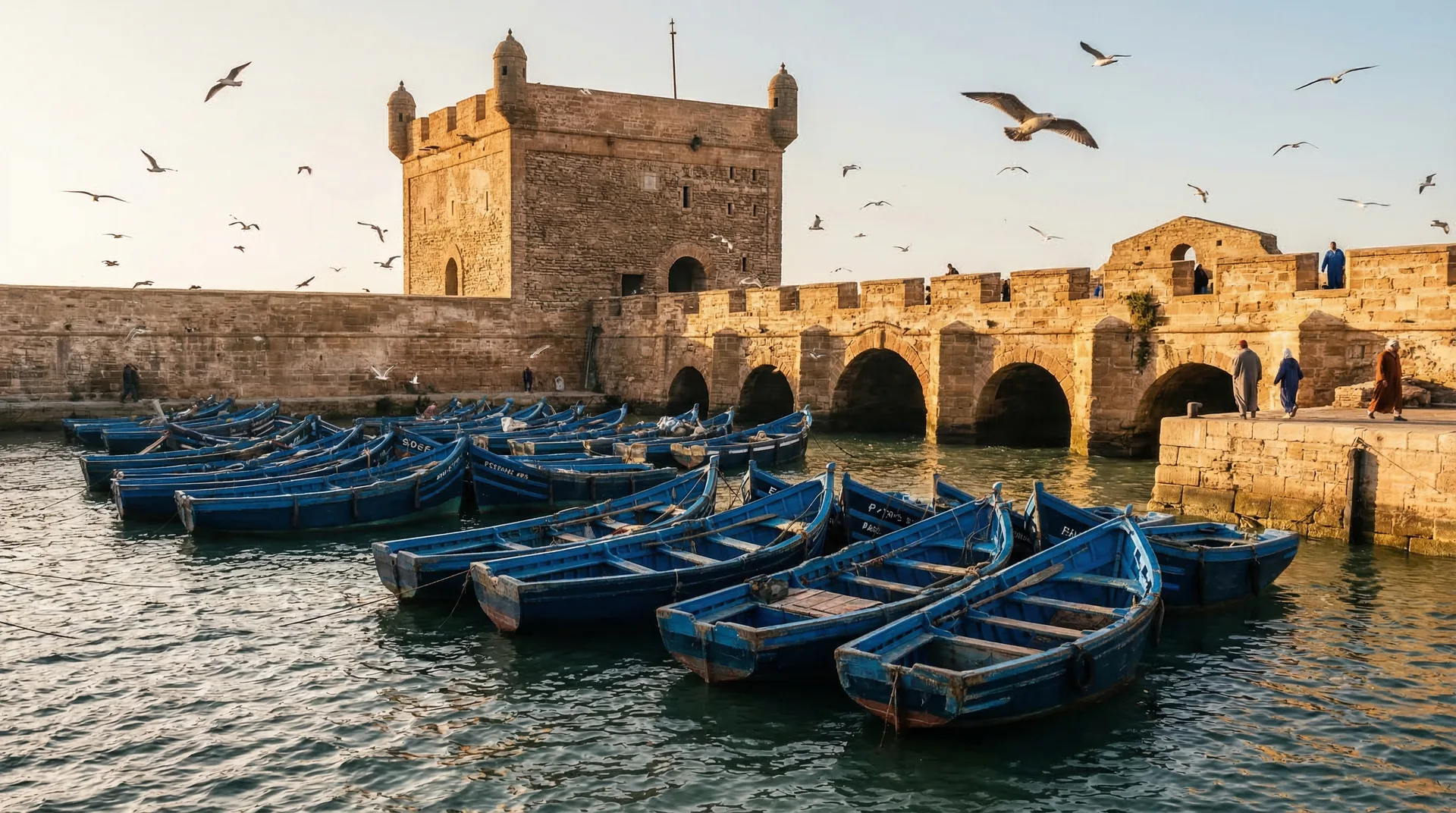
Essaouira was built to face the Atlantic. The eighteenth-century walled town — old Mogador — opens onto a wide bay where the trade wind blows steadily and the fishing fleet paints the harbour cobalt blue. After the dust and crush of Marrakech, the cool sea air feels like a reward. The medina is flat and forgiving, the port smells of grilled sardines, and the whole place runs at the pace of the tide.
The ramparts and the Skala
Start on the walls. The Skala de la Ville — the long sea-bastion lined with old bronze cannons — is the town's signature walk, with the spray coming over the parapet when the swell is up. Below it, the Skala du Port and its blue gate (you may recognise it from films shot here) frame the working harbour. Walk the ramparts at golden hour, when the light hits the white walls and the gulls wheel over the bay. We can fold a guided medina and ramparts walk into your stay.
The port and the fish grills
Essaouira's working port is the heart of the town. In the late morning the blue boats land their catch, and the auction by the dock is pure theatre. The grill stalls between the harbour and Place Moulay Hassan let you choose your fish from the ice — sardines, sea bream, calamari, the odd lobster — and watch it cooked over coals in front of you. Eat it with bread, a squeeze of lemon and a tomato salad, for a fraction of what a restaurant charges.
For a calmer meal, the rooftop terraces around Place Moulay Hassan serve the same seafood with a view of the masts and the wind — an easy, gentle option as the afternoon breeze drops.
The beach and the wind
The great crescent of sand south of the medina is the reason windsurfers and kitesurfers call Essaouira "Windy City". The afternoon alizés make it one of the best learning bays in the world; the rental and school cabins line the beach near the town end. If you would rather not get wet, walk the sand toward the ruined Bordj el Berod — the tower said to have inspired a Hendrix song — or ride a horse or camel along the tide line at dusk.
Thuya wood and the artisans
Essaouira is Morocco's capital of thuya woodwork — the fragrant, burled root of the local conifer, turned and inlaid into boxes, bowls and chess sets. The workshops cluster under the ramparts near the Skala, and you can watch the carvers at work before you buy. The town is also a long-standing painters' colony; small galleries dot the quiet lanes off the main souks.
Argan, amlou and the souks
Essaouira sits in the heart of argan country, and the medina is the place to buy proper argan oil — culinary or cosmetic — and amlou, the addictive almond, argan-oil and honey spread eaten at breakfast. The souks are gentler and less frantic than Marrakech's, good for jewellery, raffia bags and spices. Prices are softer and the haggling gentler still. Ask us about the best of it when you plan your trip through our Essaouira destination page.
Where to stay
Stay inside the medina in a converted riad for the atmosphere — a sheltered courtyard out of the wind, a rooftop for sundowners and everything on foot — or out along the beach for a larger, sea-facing hotel with easy access to the surf schools. The best-run riads here are easygoing and full of light, without fuss. We maintain a shortlist with honest assessments of what each suits — a windsurfing couple, a family wanting a pool, guests prioritising the rooftop view. Ask us when you plan the trip.
A brief practical note: Essaouira is breezy, and the afternoon wind can chill the beach even in summer. A windproof layer, something to keep sand out of your eyes, and a riad with a courtyard make the difference between a great day and a gritty one.
Getting there and when to go
Essaouira is two and a half to three hours from Marrakech by private vehicle across the argan plains, and has its own small airport, so it works beautifully as the start or finish of a coastal loop. We always use a licensed driver who knows the road and can stop at an argan women's cooperative on the way. Spring (April–June) and early autumn (September–October) are ideal: warm, sunny and a touch less windy. June brings the Gnaoua and World Music Festival, when the whole town becomes a stage. Because of the Atlantic, Essaouira stays cool and pleasant when inland Morocco bakes.
Frequently asked
How far is Essaouira from Marrakech?
Essaouira is about 190 km west of Marrakech, roughly two and a half to three hours by road across the argan plains. There is no train, but frequent coaches and private transfers make the run, and Essaouira has its own small airport (Mogador) with seasonal European flights. Many travellers use it as a calm Atlantic finish after the heat and bustle of Marrakech.
Is one weekend enough time in Essaouira?
Two nights is the sweet spot. The walled medina is compact and walkable, so a weekend lets you wander the ramparts, watch the blue boats unload at the port, eat grilled fish, browse the thuya-wood workshops and still have an afternoon for the beach or a windsurf lesson. Three nights lets you add Sidi Kaouki or Diabat without rushing.
Is Essaouira windy all the time?
The trade wind — the alizés — blows hard most afternoons from spring to autumn, which is exactly why windsurfers and kitesurfers love the bay. It keeps the town cool even in summer but can chill the beach. Mornings are usually calmer; pack a windproof layer, and choose a riad with a sheltered courtyard if you want stillness.
What should you eat in Essaouira?
Seafood, straight off the boats. The grill stalls between the port and Place Moulay Hassan let you pick your fish from the ice and have it cooked on the spot — sardines, sea bream, calamari, the odd lobster. Beyond fish, look for argan oil and amlou (an almond-argan-honey spread), and a glass of mint tea on a rooftop as the wind drops at dusk.
Is Essaouira good for families and solo travellers?
Yes to both. The medina is flat, low-key and far less frantic than Marrakech, the beach is broad and safe for paddling, and the easy seaside rhythm suits children and solo travellers alike. The town is very used to international visitors and the atmosphere is notably relaxed; normal medina caution applies after dark.
When is the best time to visit Essaouira?
Spring (April–June) and early autumn (September–October) are ideal: warm, sunny and a little less windy than high summer. June brings the Gnaoua and World Music Festival, when the whole town becomes a stage. Winter is mild but breezy and quieter. Whatever the month, Essaouira stays cooler than inland Morocco thanks to the Atlantic.
Essaouira calls
Add a weekend on the Atlantic to your Morocco itinerary.
We build Essaouira seamlessly into longer programmes — private transport from Marrakech, a handpicked riad inside the walls, a ramparts walk and a port fish dinner. Two nights is the minimum we recommend; three lets you breathe.
Plan your Essaouira stay