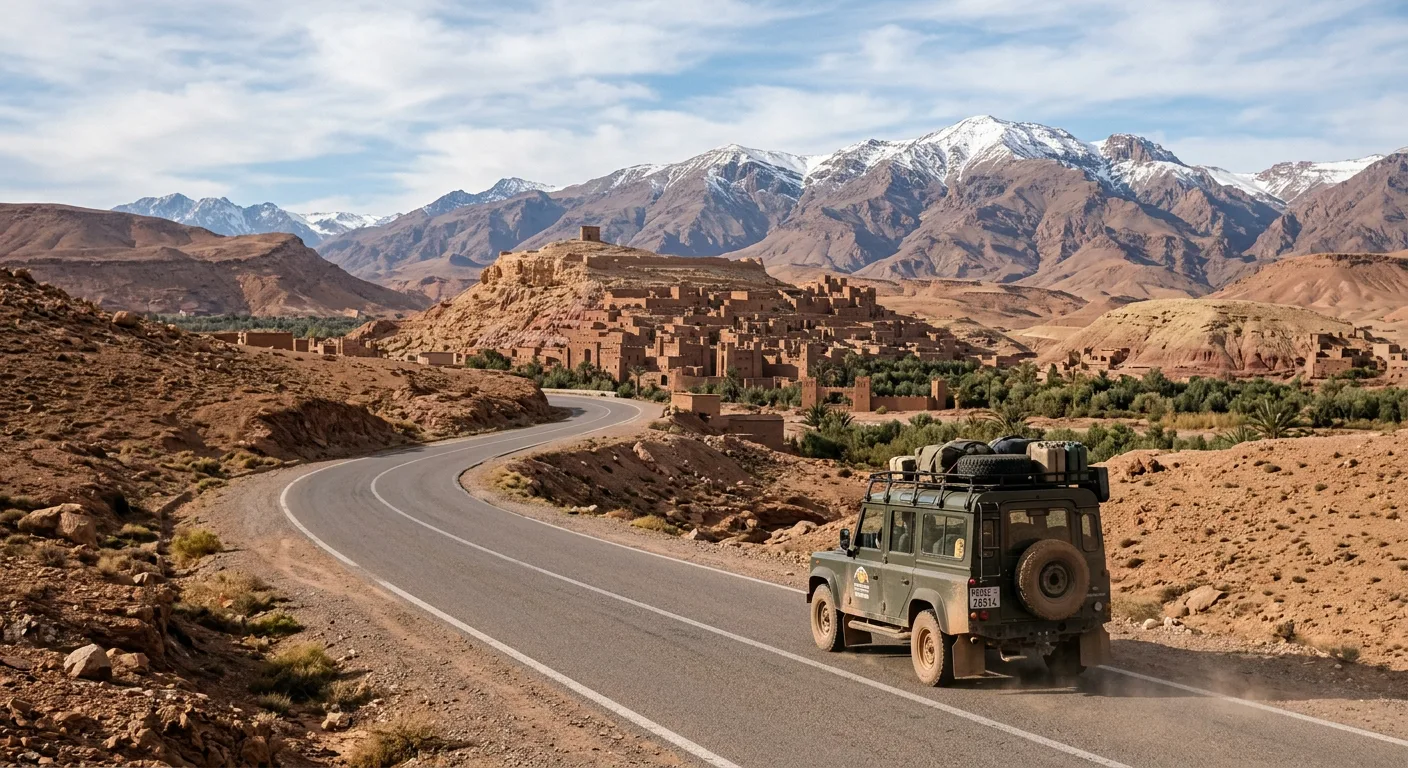
Morocco has good trains between the main northern cities, comfortable intercity buses, and — for the coast, the south and the desert — private drivers. Essaouira sits off the rail map, so reaching it means the bus (Supratours and CTM) or a private car from Marrakech. The right mix depends on your route and pace.
In this guide
Trains, buses and the private car
The ONCF rail network links Tangier, Rabat, Casablanca, Fes, Meknes and Marrakech, including the Al Boraq high-speed line (Tangier–Casablanca in about two hours). Essaouira, however, has no train station — the line ends at Marrakech, three hours inland. To reach the coast you take a Supratours or CTM coach (both run several times daily from Marrakech, roughly 2.5–3 hours and timed to connect with the trains) or a private driver. The same applies to Chefchaouen, the Atlas, Ouarzazate, the gorges and the Sahara: bus or private car.
Why most visitors use a private driver
For anything off the rail corridor, a private driver-guide is the comfortable choice: door-to-door from your riad, all your luggage, your own schedule, and the freedom to stop at a viewpoint, a co-op or a kasbah on the way. The Atlas passes and desert pistes are demanding to self-drive, and a good driver doubles as a guide and translator.
Taxis and city transport
Within Essaouira, the medina is small and entirely walkable — you rarely need transport once you've arrived. For the run to the beach, the bus station or Sidi Kaouki, small blue-and-white 'petit taxis' handle short hops; agree the fare or insist on the meter. Larger 'grand taxis' run fixed routes to nearby villages. For airport arrivals at Marrakech or Essaouira-Mogador, a pre-booked private transfer with a flight-tracked, name-board pickup spares you the arrivals-hall haggling entirely.
Frequently asked
Is it better to take the train or hire a driver in Morocco?
On the Tangier–Rabat–Casablanca–Fes–Marrakech corridor, the train is fast and cheap. For Essaouira (no rail link), Chefchaouen, the Atlas, Ouarzazate and the Sahara, you choose between the long-distance bus and a private driver — the latter being the comfortable, flexible option, especially for the scenic Marrakech–Essaouira coast road through the argan forest.
Should I rent a car in Morocco?
Self-driving is fine on the motorways but demanding in the medinas (no cars), the Atlas passes and the desert pistes. Most visitors prefer a private driver, who also navigates, translates and guides.
How do I get from the airport to my riad?
Pre-book a private transfer with a fixed price and a name-board pickup. From Marrakech Menara it is about three hours to Essaouira along the argan-forest coast road; from Essaouira-Mogador airport it is around 20 minutes. The Essaouira medina is partly car-free, so your driver drops you at the nearest gate and you walk the last few minutes to the riad door.
Planning a trip?
Let an Essaouira atelier handle the details.
Tell us your dates and style and we'll send a written itinerary and a transparent quote within 24 hours.
Request an itineraryKeep reading
Planning
Morocco Travel Costs & Budget
Morocco can be done on almost any budget, and Essaouira is gentler on the wallet than Marrakech for comparable quality. Mid-range travellers spend roughly US$70–140 per person per day on the coast; private, riad-based trips with a driver-guide typically run US$200–400+ per day depending on season and style.
Planning
Is Morocco Safe to Visit?
Yes — Morocco is one of the safest and most welcoming countries in North Africa for travellers, and Essaouira is among its most relaxed corners: a small, grid-planned port medina where the hustle is gentle and the pace is unhurried. The main day-to-day issues are petty scams and a little market hassle, both easily managed.
Planning
The Best Time to Visit Morocco
Spring (March–May) and autumn (September–November) are the best all-round times to visit Morocco — and if you base yourself on the Atlantic in Essaouira, the breezy coast stays comfortable even when the interior bakes. Here is how the seasons play out across the windswept port, the medinas, the High Atlas and the Sahara.