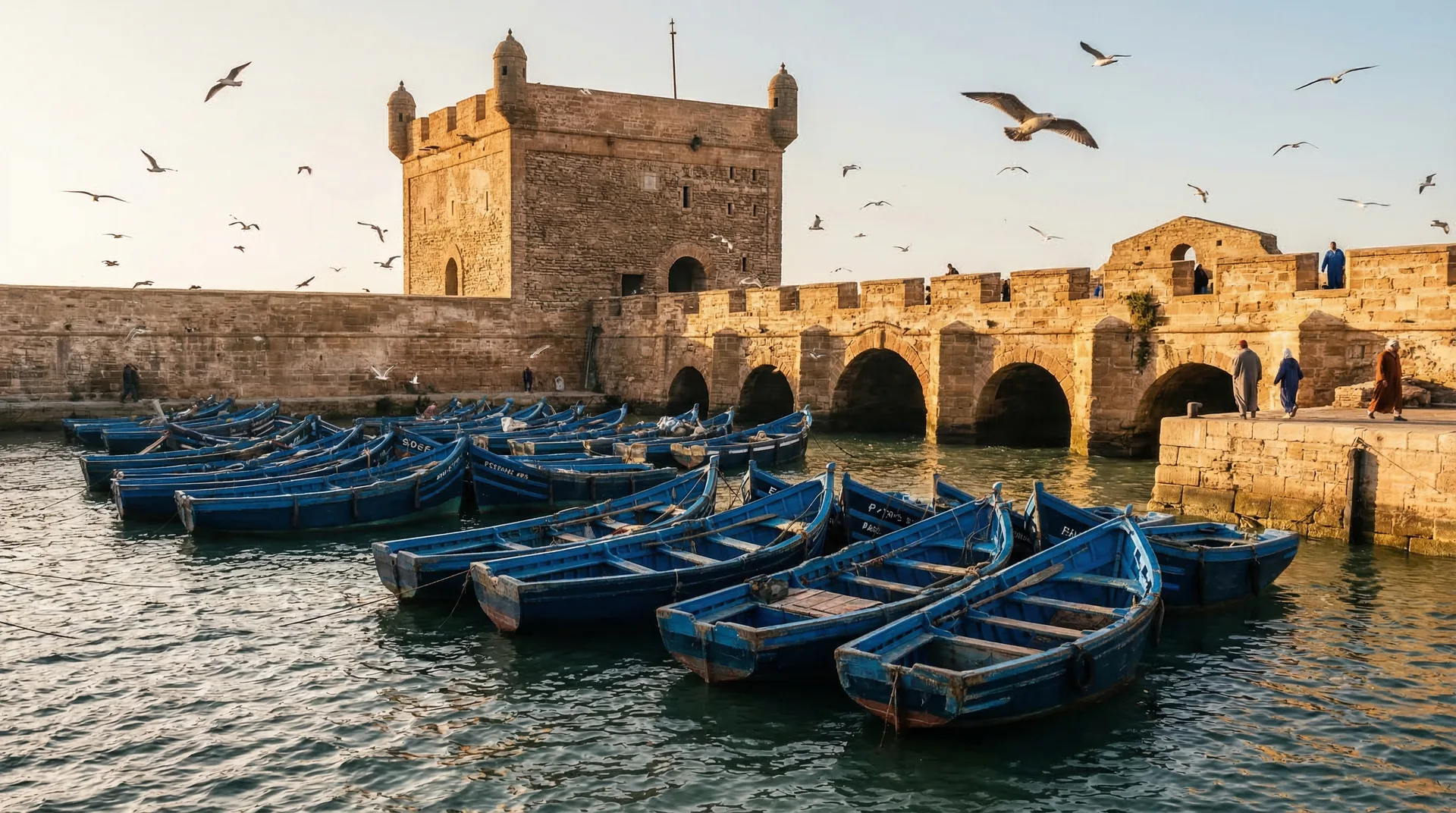
Just off Essaouira's coast — roughly two kilometres out across the bay — lies a small archipelago known as the Îles Purpuraires, dominated by the Île de Mogador. The name carries deep history: in Phoenician and Roman times these islands were tied to the production of Tyrian (royal) purple dye, extracted from murex sea-snails, and the dye works are why they are called the 'Purple Islands'. The main island holds the ruins of an old fortress and prison and a small mosque, and today the whole group is a protected nature reserve and one of the most important breeding sites for the rare Eleonora's falcon. For that reason landing is restricted and generally not permitted — you usually admire the islands from the shore, the ramparts and the beach rather than setting foot on them. This is a guide to the view, the purple-dye history, the fortress ruins, the falcon reserve and how to experience the islands responsibly.
The classic way to see the islands is from Essaouira's seaward defences. From the Skala de la Ville's cannon walk and the harbour ramparts you look straight out across the bay to the low silhouette of the Île de Mogador and the smaller islets, with the old fort breaking the horizon. On clear days the outline is sharp; in haze it floats faintly offshore.
02Coast
Watching the islands from the beach
Essaouira's long main beach gives an unbroken sightline to the archipelago, especially as you walk south toward the bay's curve. It is an easy, free vantage point — the islands sit a couple of kilometres out, so they read as a distant profile of fort and rock rather than fine detail. Bring binoculars if you want a closer look.
03History
The purple-dye history and the name 'Purpuraires'
The islands' name comes from the ancient purple-dye industry. In Phoenician and later Roman times, Tyrian purple — the costly 'royal purple' reserved for elites — was produced from murex sea-snails harvested along this coast. Archaeological evidence of this dye production has been associated with the Mogador area, which is why the group is called the Îles Purpuraires, the Purple Islands.
04Ruins
The fortress and prison ruins
The main island carries the remains of an old fortress that also served as a prison, together with a small mosque. The fortifications are usually attributed to the era of Sultan Sidi Mohammed ben Abdallah, who rebuilt Essaouira (then known as Mogador) as a fortified trading port in the 1760s. The ruins are visible from the mainland but, as a protected reserve, the island itself is generally off-limits to visitors.
05Wildlife
The Eleonora's falcon reserve
The Îles Purpuraires are a protected nature reserve and an internationally important breeding site for Eleonora's falcon, a migratory raptor that nests on the islands' cliffs in summer and autumn. The colony is one of the largest of its kind, which is the main reason public access to the islands is restricted — to avoid disturbing the breeding birds.
06Conservation
Why landing is restricted
Because of the falcon colony and the islands' protected status, landing is generally not permitted and access is tightly controlled. Most visitors experience the archipelago only from the shore or by boat circling offshore. Rules can change and special permits may apply for research, so always check current local regulations rather than assuming you can step ashore.
07On the water
Boat trips around the bay
From Essaouira's port, boat outings around the bay are sometimes offered, and licensed trips may pass near the islands without landing. Availability, operators and exactly how close boats can go vary with the season, the weather and conservation rules, so confirm details locally before booking — and treat any claim of 'landing on Mogador' with caution given the reserve restrictions.
08Wildlife
Birdwatching from the mainland
You don't need to reach the islands to enjoy the wildlife. In the right season, falcons and seabirds can be watched with binoculars or a long lens from the ramparts and the southern end of the beach. The waters around the bay also draw gulls and other seabirds, making the seafront a rewarding spot for casual birdwatching.
09Photography
Photography and the sunset
The islands make a natural foreground-to-horizon subject from the Skala and the beach, and they sit roughly to the west, so they often feature in Essaouira's celebrated Atlantic sunsets. Late afternoon light warms the ramparts and the sea, with the fort's silhouette anchoring the frame — a long lens helps pull the distant island closer.
10Itinerary
Combining the islands with the port and ramparts
Seeing the islands fits naturally into a walk of Essaouira's seafront. Pair the view with the Skala de la Ville's cannons, the harbour bastion and the working fishing port, then continue along the beach for changing angles on the archipelago. It makes an easy half-day loop combining history, defences and coastal scenery.
Frequently asked
Can you visit or land on the Île de Mogador?
Generally no. The Îles Purpuraires are a protected nature reserve and an important breeding site for Eleonora's falcon, so landing is restricted and usually not permitted to avoid disturbing the birds. Most people admire the islands from Essaouira's ramparts, beach or by boat without going ashore. Rules can change, so check locally.
Why are they called the Îles Purpuraires (Purple Islands)?
The name comes from the ancient purple-dye industry. In Phoenician and Roman times, Tyrian or 'royal' purple was produced from murex sea-snails along this coast, and that dye production is associated with the Mogador area — giving the archipelago its name, the Purple Islands.
What is on the main island?
The Île de Mogador holds the ruins of an old fortress that also served as a prison, along with a small mosque. The fortifications are usually linked to the 18th-century rebuilding of Essaouira as a fortified port. Because the islands are a protected reserve, the ruins are normally viewed only from the mainland.
How do I see the islands from Essaouira?
The easiest free vantage points are the Skala de la Ville ramparts, the harbour bastion and the main beach, all of which look out across the bay to the islands about two kilometres offshore. Binoculars or a long lens help, and late afternoon light is especially good for photography.
See it with a local
Turn this into a private Essaouira trip.
We'll build a private, guided plan around the experiences you care about — with a driver, hand-picked riads and a written quote in 24 hours.