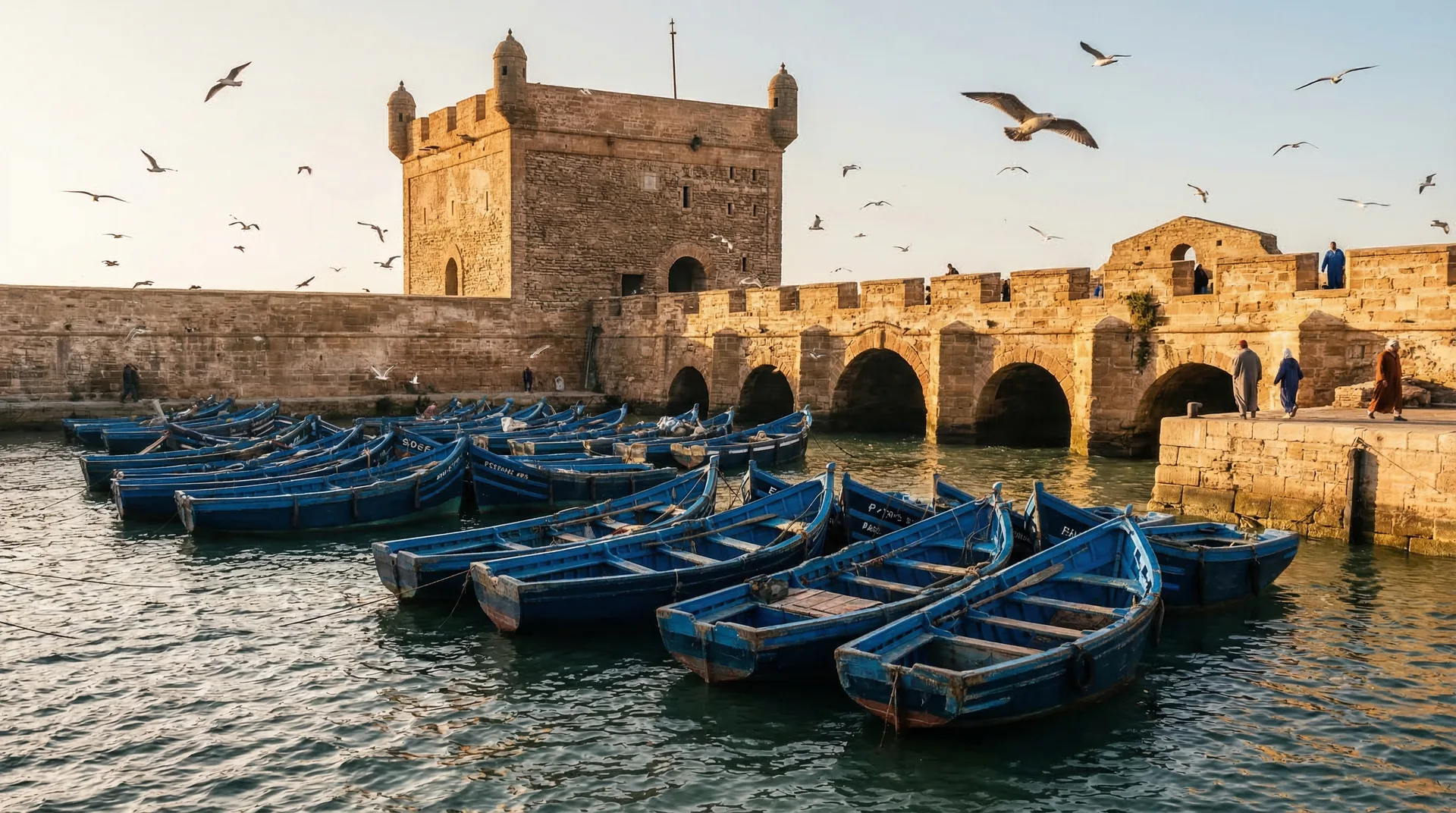
Few Moroccan towns wear their Jewish past as openly as Essaouira. When the planned port of Mogador was built in the 1760s, Sultan Sidi Mohammed ben Abdallah invited Jewish merchants to settle and run the kingdom's Atlantic trade, and for a time the community made up a large share of the town — at points close to half its population. They lived in two mellahs in the medina's northern quarter, worshipped in dozens of small synagogues, and left a heritage that the town has spent recent years restoring. This is a walking guide to the Mellah, the synagogues, the Bayt Dakira heritage house and the old cemetery — a side of Essaouira that sits quietly within the UNESCO medina.
In the medina's northern corner lies the Mellah, the historic Jewish quarter laid out when Mogador was founded in the 1760s. As the community grew, a second 'new mellah' was added beside it. The lanes are weathered today and some buildings stand empty, but the dense, tall houses and old doorways still mark out one of the most significant Jewish quarters in Morocco's history.
02Museum
Bayt Dakira, the House of Memory
Bayt Dakira ('House of Memory') is a restored 19th-century building, reopened in 2020, that serves as a museum and spiritual heritage centre dedicated to the town's Judeo-Moroccan past. Inside is the carefully restored Simon Attias synagogue along with photographs, documents and displays on the community. It is the natural starting point for understanding Essaouira's Jewish story.
03Synagogue
The Haim Pinto Synagogue
Tucked into the Mellah is the synagogue of Rabbi Haim Pinto, a revered 19th-century sage whose family remains important in Moroccan-Jewish tradition. The small, intact synagogue and his nearby tomb are still cared for, and pilgrims visit, especially around the annual hiloula (memorial pilgrimage) held in his honour.
04Synagogue
The Simon Attias Synagogue
Within Bayt Dakira sits the restored Simon Attias synagogue, named for a prominent merchant family of Mogador. Its woodwork, bimah and ark were brought back from years of neglect during the heritage project, making it one of the most evocative restored interiors in the town.
05Heritage
The merchant houses and the 'tujjar al-sultan'
Mogador's Jewish and foreign merchants included the tujjar al-sultan — 'the sultan's traders' — given royal licences to handle the kingdom's overseas commerce in goods like sugar, tea, ostrich feathers and gum. The large merchant houses and former consulates near Place Moulay Hassan and the port reflect the wealth that this cosmopolitan trade once brought through Essaouira.
06History
The old Jewish cemetery
Outside the walls, near the sea, lie the town's Jewish cemeteries, where generations of Mogador's community are buried alongside the tombs of revered rabbis. The site is gated and looked after; it can usually be visited respectfully, and a caretaker is often on hand. As an active religious site, modest dress and quiet are expected.
07Context
André Azoulay and the town's revival
Essaouira's most prominent living son, André Azoulay, a senior royal adviser born in the town, has been central to celebrating its plural heritage — from the Bayt Dakira project to the Andalusian and Atlantic festivals. It is part of why Essaouira presents its Jewish, Amazigh and Andalusian threads as one shared story rather than a forgotten one.
08Culture
Festivals of shared heritage
The town's cultural calendar leans into this mixed past. The Festival des Andalousies Atlantiques, held in the autumn, brings together Jewish and Muslim Andalusian musicians on the same stage, and the famous Gnaoua festival celebrates the Afro-Moroccan tradition. If your visit overlaps, they are a living way to encounter the heritage the Mellah preserves in stone.
09Walk
Reading the medina's mixed fabric
Walking from Bab Doukkala through the Mellah toward the souks, you pass mosques, the quarters of the old Jewish community and the merchant medina side by side within a single set of walls. This compact layering of communities is exactly why UNESCO inscribed the Essaouira medina in 2001 as a rare example of a late-18th-century fortified North African town.
10Itinerary
Combining it with the wider medina
The Mellah, Bayt Dakira and the Haim Pinto synagogue sit within easy walking distance of Place Moulay Hassan, the Skala ramparts and the souks, so the Jewish-heritage trail slots neatly into a half-day medina walk. A local guide can open doors and add the history, though much of the quarter can also be explored quietly on your own.
Frequently asked
Why was Essaouira such an important Jewish town?
When the port of Mogador (today's Essaouira) was built in the 1760s, the sultan invited Jewish merchants to settle and run Morocco's Atlantic trade. The community grew to a very large share of the town's population and produced influential merchant families, rabbis and the 'tujjar al-sultan', the sultan's licensed traders, leaving one of the most significant Jewish heritages in Morocco.
Can you visit the synagogues and the Mellah in Essaouira?
Yes. Bayt Dakira, the restored heritage house, is open as a museum and includes the Simon Attias synagogue. The Haim Pinto synagogue in the Mellah is cared for and can usually be visited, and the old Jewish cemetery is gated but generally accessible with respect. Opening times and access can vary, so it is worth checking locally or going with a guide.
What is Bayt Dakira?
Bayt Dakira, the 'House of Memory', is a restored 19th-century building in the medina, reopened in 2020, that works as a museum and spiritual-heritage centre devoted to Essaouira's Judeo-Moroccan past. It houses the restored Simon Attias synagogue along with photographs, documents and exhibits, and is the best place to begin a Jewish-heritage visit.
Are there still Jewish residents in Essaouira?
Only a very small number remain today, as most of the community emigrated during the 20th century. But the heritage is actively preserved — through Bayt Dakira, the maintained synagogues and cemetery, the annual Haim Pinto pilgrimage, and festivals that celebrate the town's shared Jewish, Amazigh and Andalusian past.
See it with a local
Turn this into a private Essaouira trip.
We'll build a private, guided plan around the experiences you care about — with a driver, hand-picked riads and a written quote in 24 hours.