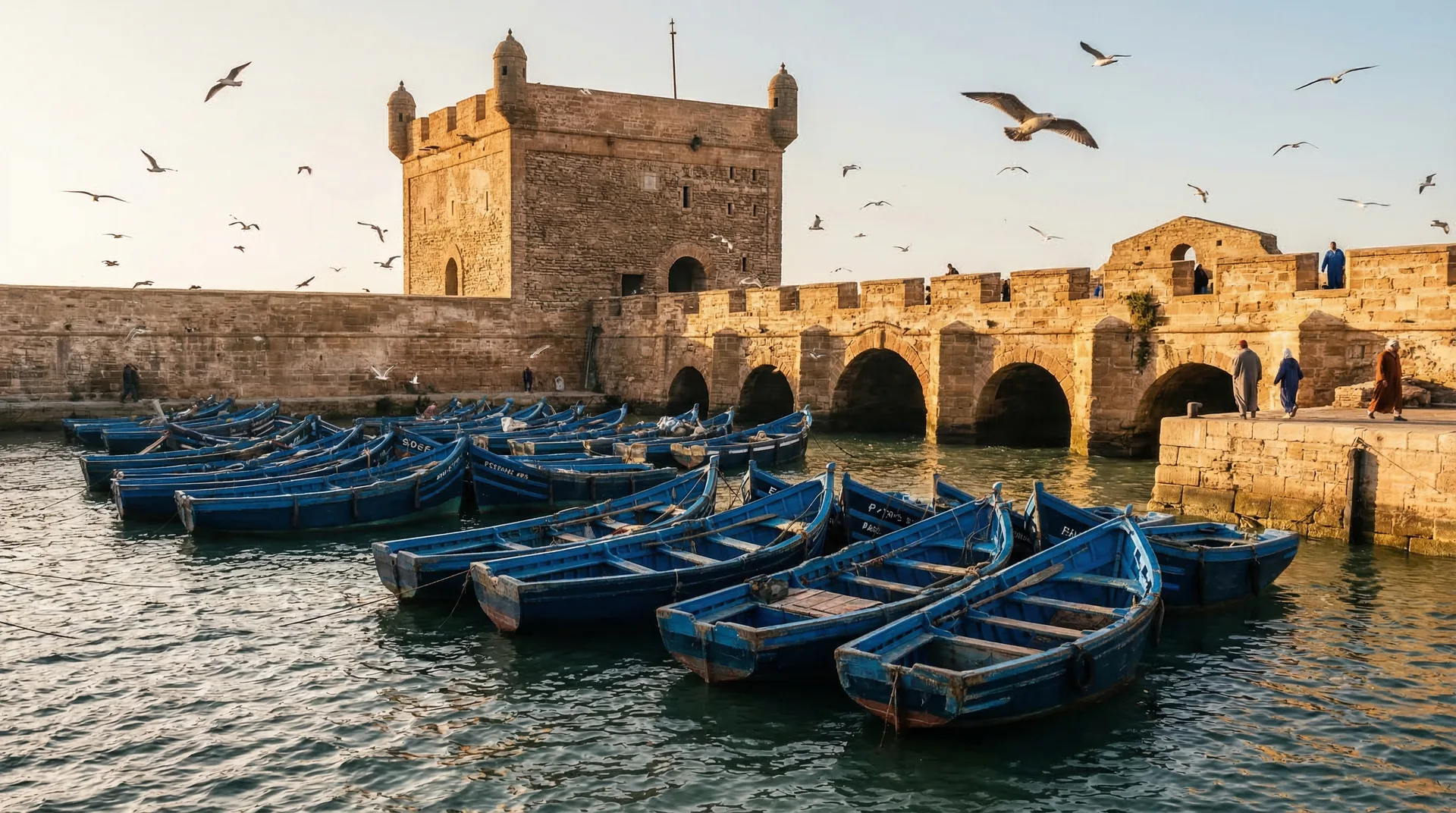
Essaouira's working fishing port is one of the town's most atmospheric and photogenic corners — rows of bright blue wooden boats crowded along the quay, the daily catch landed and sorted in the open air, gulls wheeling overhead and the smell of grilling sardines. It sits beneath the Skala du Port, the harbour bastion with its sea gate (the Porte de la Marine), part of the 18th-century fortifications that frame the UNESCO-listed medina. This is a guide to the blue boats, the fish auction, the grill stalls, the port ramparts and the boat-builders still working timber on the slipway — distinct from the Skala de la Ville city ramparts above the medina.
The defining sight of the port is the fleet of small wooden fishing boats, almost all painted the same vivid blue, packed gunwale to gunwale along the quay. They are the workhorses of Essaouira's inshore fishery, and watching crews unload, mend nets and tie up is the heart of a visit — busiest in the morning when the boats come in.
02Market
The fish auction and the quayside market
The day's catch is landed, sorted into crates and sold on the quay, with a lively auction among buyers and restaurateurs. Sardines, conger eel, sea bream, sole, squid and shellfish are common on the Atlantic coast here. It is a working market rather than a tourist set-piece, so it stays authentic and a little chaotic — keep clear of the trolleys and the porters.
03Food
The open-air grill stalls
A cluster of open-air grill stalls sits between the port and Place Moulay Hassan, where you point at fresh fish and seafood on ice and have it grilled on the spot. It is a classic Essaouira experience. Agree the price before anything goes on the grill, check it is by weight, and choose a stall that looks busy with good turnover and fish kept properly on ice.
04Ramparts
The Skala du Port bastion
Guarding the harbour is the Skala du Port, a square fortified bastion you can climb for views over the boats, the quay and back to the medina ramparts. Like the rest of the defences it dates to the 1760s rebuilding of the port under Sultan Sidi Mohammed ben Abdallah. A small entry charge has usually applied — check on arrival.
05History
The Porte de la Marine sea gate
The grand archway linking the medina to the harbour is the Porte de la Marine, an 18th-century gate of European-influenced design built when Essaouira (then Mogador) was laid out as a fortified royal trading port. It frames the walk down to the boats and is one of the town's most recognisable landmarks.
06Crafts
The traditional boat-builders
Along the slipway you can still see shipwrights building and repairing wooden boats by hand, shaping timber and caulking hulls much as has been done here for generations. Essaouira remains one of the Moroccan ports where traditional wooden vessels are made, and the open yards are a quiet highlight away from the main quay.
07Atmosphere
The gulls and the working atmosphere
Clouds of yellow-legged gulls wheel and dive over the boats as the catch is gutted and cleaned, and the whole port hums with porters, ice, engines and bargaining. It is loud, salty and alive — the most unfiltered scene in Essaouira, and very different in feel from the calm of the medina lanes.
08Photography
Photography and the best light
The massed blue boats against weathered stone and a wide Atlantic sky make this Essaouira's signature shot. Morning gives the busiest quay and the boats returning; late afternoon gives warm, low light on the hulls and the ramparts. As always at a working port, be respectful and ask before photographing people closely.
09Context
Sardines and a note on sustainability
Essaouira is historically one of Morocco's notable sardine ports, and sardines are the staple of the grill stalls and the local diet. As with fisheries worldwide, catches fluctuate and pressure on stocks is a real concern, so choosing what is fresh and abundant on the day — rather than a particular prized fish — is the sensible approach.
10Itinerary
Combining the port with the medina and ramparts
The port sits just outside the medina by Place Moulay Hassan, so it slots naturally into a wider walk: the boats and grill stalls, up onto the Skala du Port, then through the Porte de la Marine into the old town and along to the Skala de la Ville sea ramparts. Together they make a full loop of Essaouira's seaward defences.
Frequently asked
Is Essaouira's fishing port worth visiting?
Yes — it is one of the town's most atmospheric spots, with rows of bright blue wooden boats, a working fish auction, grill stalls and the Skala du Port bastion. It is a genuine working port rather than a tourist attraction, which is exactly what makes it memorable.
What is the best time to see the fishing port?
Mid to late morning is liveliest, when boats return and the catch is landed and sold. Late afternoon brings warmer light for photography. The grill stalls are typically busiest around lunch.
Can you eat fresh fish at the port?
Yes. Open-air grill stalls between the port and Place Moulay Hassan let you pick fresh fish and seafood to be grilled on the spot. Agree the price and confirm it is by weight before ordering, and choose a busy stall with good turnover and fish kept on ice.
Is the Skala du Port the same as the Skala de la Ville?
No. The Skala du Port is the smaller bastion guarding the harbour, with the Porte de la Marine sea gate. The Skala de la Ville is the larger rampart walk lined with cannons along the medina's western wall. Both are part of Essaouira's 18th-century fortifications and pair well on one walk.
See it with a local
Turn this into a private Essaouira trip.
We'll build a private, guided plan around the experiences you care about — with a driver, hand-picked riads and a written quote in 24 hours.